

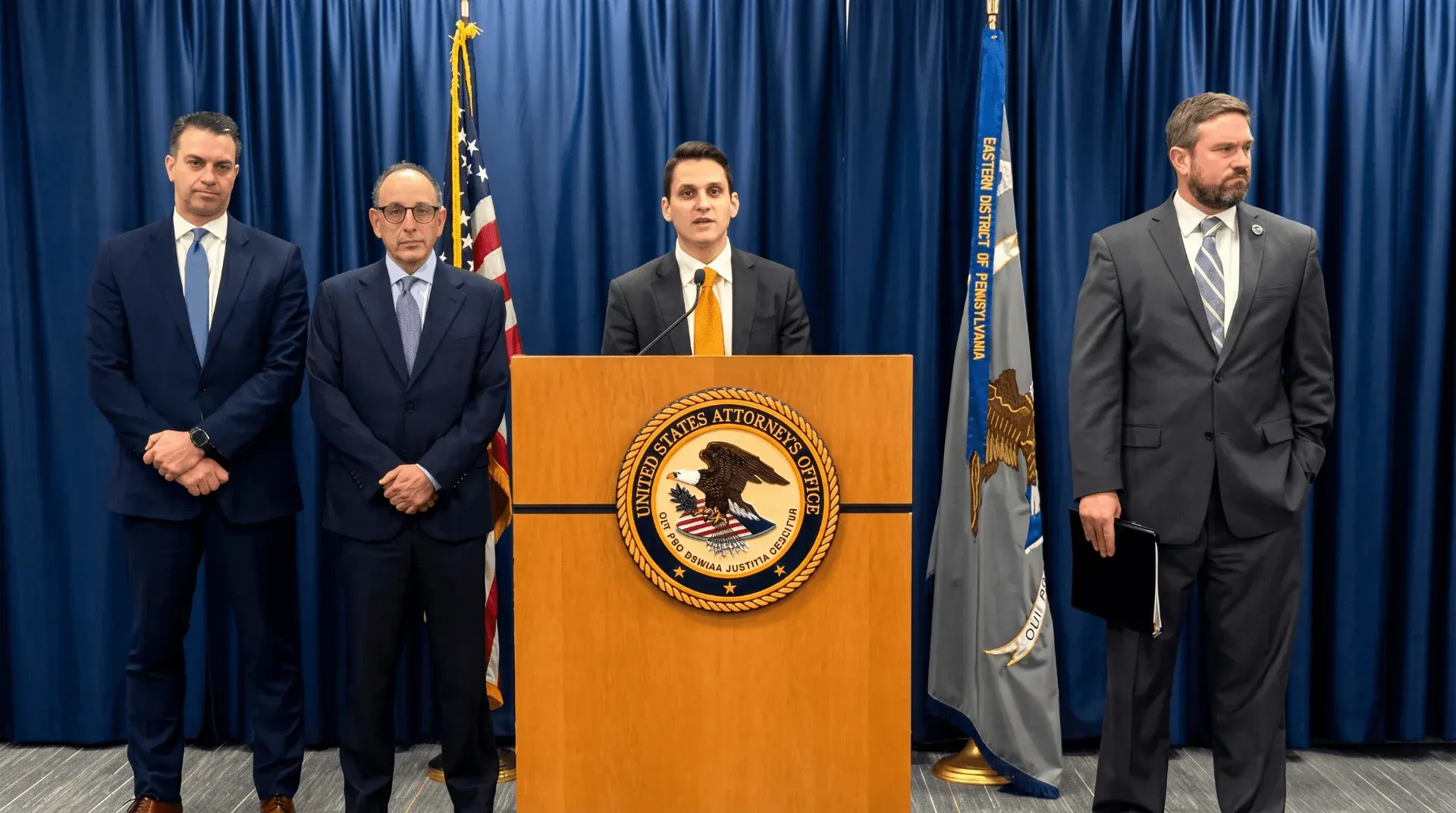
On January 15, 2026, the U.S. Attorney's Office for the Eastern District of Pennsylvania unsealed a federal case that shook the world of basketball. Twenty-six people were charged in a single international conspiracy — the mass fixing of NCAA Division I and Chinese Basketball Association (CBA) games.
More than 39 players. Seventeen universities. Twenty-nine fixed games. Two full seasons. The FBI's Philadelphia investigation had been running for two years.
And this is only the beginning.
The Full Scale of the Scheme
The federal indictment runs to 70 pages. U.S. Attorney David Metcalf discussed the case alongside FBI Deputy Director Andrew Bailey and FBI Philadelphia Special Agent in Charge Wayne Jacobs.
Metcalf described the scheme in stark terms: "A significant and rampant corruption of college athletics… an extensive international criminal conspiracy of NCAA players, alumni and professional bettors who fixed games across the country and poisoned the American spirit of competition for monetary gain."
Of those charged, 20 were themselves NCAA players during the 2023-24 and/or 2024-25 seasons. They played for schools including Tulane, SUNY Buffalo, DePaul, Kennesaw State, La Salle, Abilene Christian, Nicholls State, St. John's, Georgetown, Florida Atlantic, Fordham, Butler, Kent State, Duquesne, East Carolina, Ohio University, McNeese State, Alabama State, St. Louis University and Western Michigan.
The mechanics of the scheme were simple but financially exploitative. Players were offered between $10,000 and $30,000 per game — bribes paid to ensure their team did not "cover" the spread. This is a well-known type of scheme — point-shaving — in which a player deliberately underperforms so that a particular wager pays out.
And the scheme worked. Metcalf noted: "In basketball, one player could substantially influence a game in ways that in other sports you cannot, but it's not a guarantee. But by and large, the scheme was very successful."
CBA → NCAA — The Scheme Travels From China to America
One of the most striking elements in the federal indictment is the scheme's origin. It did not begin in the United States.
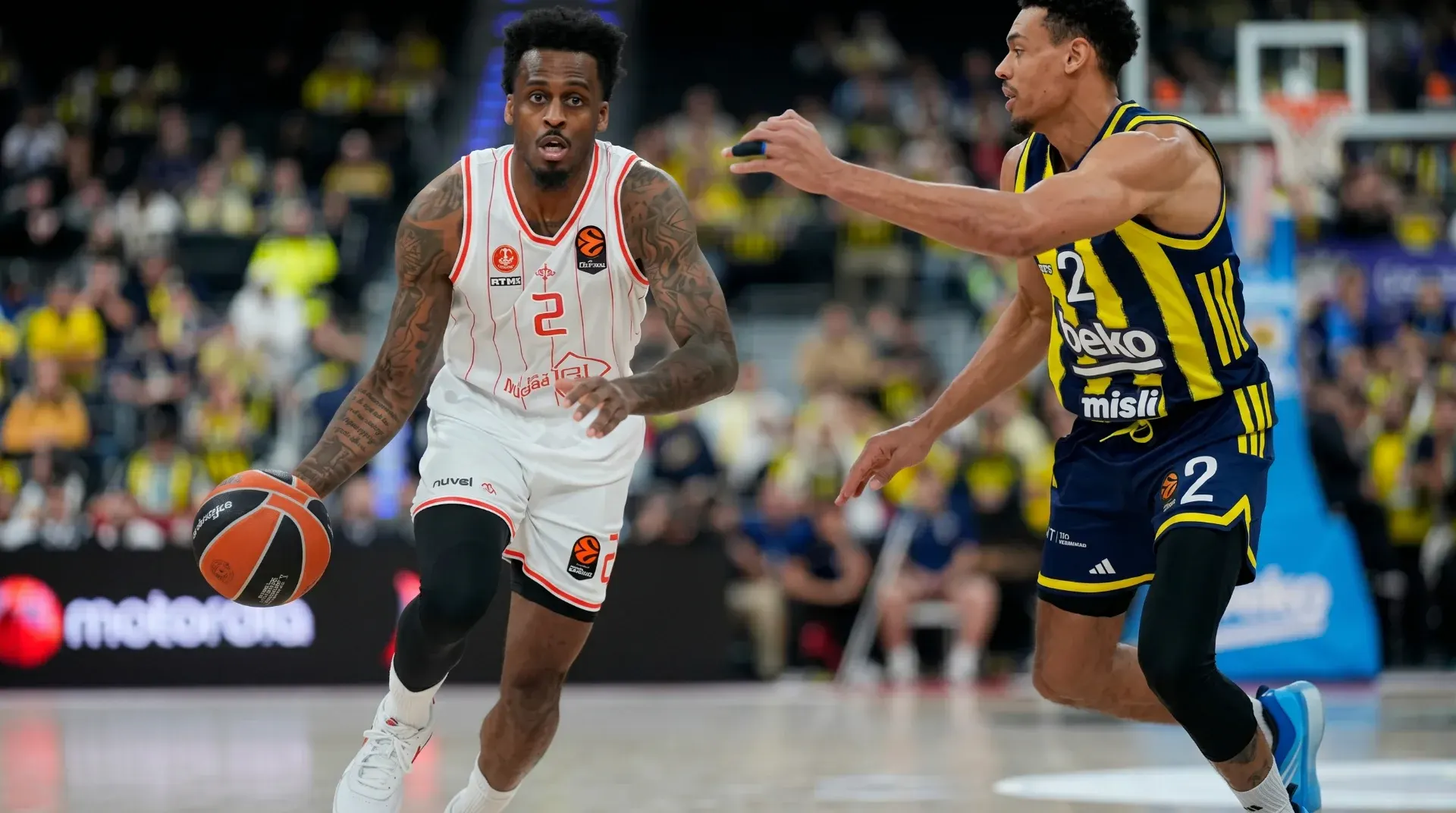
It started in the Chinese Basketball Association. The scheme was led by a group of fixers: Jalen Smith (Charlotte, NC), Marves Fairley (Carson, MS), Shane Hennen (Las Vegas/Philadelphia), Antonio Blakeney (Kissimmee, FL), Roderick Winkler (Little Rock, AR), and Alberto Laureano (Bronx, NY).
Blakeney — a former NBA player and LSU alumnus who was playing in the CBA — was the central connecting figure. Fairley and Hennen offered him money to deliberately underperform in CBA games. Blakeney agreed, and pulled in teammates as well.
The scheme worked so smoothly in the CBA that, on one occasion, Hennen messaged a co-conspirator: "Nothing is guaranteed in this world but death, taxes and Chinese basketball."
That single line laid bare the psychology of the scheme — the fixers already saw their operation as essentially risk-free money.
After the 2022-23 CBA season, Fairley placed a package into Blakeney's storage unit in Florida containing nearly $200,000 in cash — representing bribe payments and proceeds from the fixed CBA games.
Then, ahead of the 2023-24 season, the group decided to bring the scheme to the United States. They specifically recruited fixers with deep ties to college basketball — former players, alumni, trainers, recruiters, network insiders. "They picked these men because they were well connected in the world of college basketball," Metcalf explained. "Trainers, recruiters, networkers, people of influence — and because of that influence, they added gravitas and legitimacy to the scheme."
The NIL Loophole — The Fixers' Strategy
And here lies one of the most significant facts of the case — the fixers were not picking players at random. They had a deliberate strategy.
The federal indictment states explicitly that the fixers targeted players "for whom the bribe payments would meaningfully supplement, or exceed, the student-athletes' Name-Image-Likeness compensation." In other words, they targeted players who were not stars in the NCAA's NIL era.
NIL — the Name, Image and Likeness system — has been in effect since 2021. It allows student-athletes to earn money from their name, image and likeness. But the uneven distribution of NIL money handed the fixers a real opportunity. According to industry data, more than 66 percent of athletes at Power Four schools (ACC, Big Ten, SEC, Big 12) earn less than $10,000 a year from NIL deals. At mid-major and low-major level, the picture is far worse. The total NIL roster budget at lower-division schools is estimated at around $100,000 — for an entire team.
The list of schools whose players were charged points exactly to this gap. Kennesaw State, Nicholls State, Abilene Christian, McNeese State. None are household names. Many of the players had no real NIL earning potential.
And that is precisely why $10,000 to $30,000 per game was, for them, life-changing money.
NCAA president Charlie Baker called for gaming companies to end halftime wagers and cut back on prop bets, adding: "The pattern of college basketball game integrity conduct revealed by law enforcement today is not entirely new information to the NCAA."
The NCAA's own enquiries had already examined nearly 40 student-athletes from 20 schools over the past year. Eleven players from seven schools were stripped of eligibility. Another 13 athletes from eight schools failed to cooperate with the investigation.
As for the federal penalties — bribery in sporting contests carries up to 5 years in prison and a $250,000 fine. Wire fraud carries up to 20 years in prison and a $250,000 fine.
The Connection to the NBA Scheme
And this is where the true scale of the operation becomes clear. The NCAA scheme was not isolated.
Last October — three months before the NCAA indictment — the FBI carried out an unprecedented sweep across the NBA world. Thirty-four people were arrested across two separate but related federal indictments.
The first indictment — dubbed "Operation Nothing But Bet" — involved an insider sports betting scheme. Miami Heat guard Terry Rozier, former NBA player and unofficial Lakers assistant Damon Jones, and bettors including Fairley and Hennen were charged with using non-public NBA information to place illegal wagers on at least seven games between 2023 and 2024.
The second indictment involved a sprawling rigged high-stakes poker operation — one that reached into organised crime. Portland Trail Blazers head coach Chauncey Billups, inducted into the Basketball Hall of Fame in 2024, was charged with wire fraud conspiracy and money laundering conspiracy for his alleged role as a "Face Card" — a high-profile figure used to attract wealthy targets to rigged card games in Manhattan, Las Vegas, Miami and the Hamptons. The scheme used high-tech cheating equipment including marked-card readers and rigged shuffling machines. Among the defendants were 13 members and associates of the Lucchese, Bonanno, Gambino and Genovese Mafia families.
Jones was named as a defendant in both schemes.
One clear link runs through both cases — Hennen and Fairley appear in the October sports betting indictment and again in the January NCAA indictment. The fixers who corrupted NCAA programmes were also working the NBA betting markets. One network — multiple sets of victims.
The fixer network effectively covered the entire American basketball landscape — collegiate, professional, and Chinese — simultaneously.
$458,000 on a Single Game — The Scale of the Wagers
And finally, the figures that say everything.
$458,000 — a wager on Towson to beat UNC A&T. Half a million dollars on a single game.
$424,000 — a wager on Kent State to cover the first-half spread against Buffalo.
$275,000 — on South Alabama against Southern Miss.
$256,000 — another wager involving St. John's.
$168,300 — on the Guangdong Southern Tigers in the CBA.
$52,395 — on the first-half spread for St. John's.
These are simply some of the wagers listed. One of the fixers sent a photograph of approximately $100,000 in cash to Kennesaw State guards Simeon Cottle and Demond Robinson ahead of their March 1, 2024 game against Queens University. The wagers were not theoretical — the cash was physical, real, and changing hands.
Metcalf summarised the federal case directly: "To capitalize on this scheme, the fixers made wagers totaling millions of dollars, generating substantial proceeds. The players collectively received hundreds of thousands of dollars in bribe payments for fixing their teams' basketball games."
Millions. From a single scheme. Over two seasons. Running simultaneously through three leagues on two continents.
For the fixers, this is what "death, taxes and Chinese basketball" looked like.
One of them was right — all three turned out to be unavoidable.